Glencruitten House, Oban: The Story Behind Scotland's Fairytale Manor
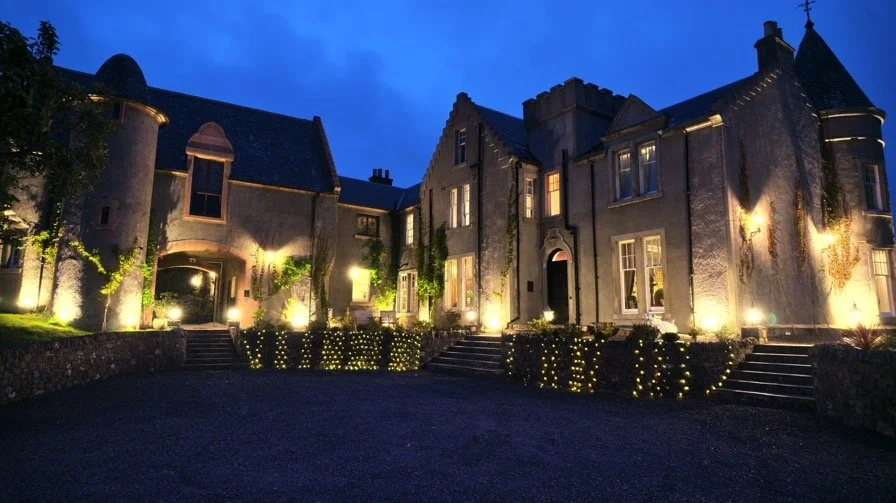
It's evening when I first see Glencruitten House, the last blue light still in the sky, and my first thought is that it doesn't look like a hotel at all. Turrets. Crow-stepped gables. Stone walls lit gold against the dark. It looks like something drawn for a children's book — which, it turns out, is closer to the truth than I expected. Every room inside is named after a figure from Scottish folklore. And the man who shaped this place spent the second half of his life trying to build something that would outlast him, in ways that have nothing to do with the house at all.
The Man Who Built a Cathedral Out of Trees
His name was Alexander Mackay — a Dundee-born businessman with a hand in almost everything: timber in British Columbia, copper mining, a cattle ranching company, even an early stake in Shell Oil. By the time he arrived at Glencruitten, in the mid-1910s, he'd already lived a life that spanned continents; he'd married in Nova Scotia, done business on three sides of the Atlantic, and lost his previous home to a fire in Broughty Ferry, on Scotland's east coast. Glencruitten was where he decided to settle.
He was in his sixties when he began planting. The estate was mostly moorland and rough grazing, and Mackay set about turning much of it into forest — partly to help replace the timber Britain had burned through during the First World War, and partly to give work to the men coming home from it. Many of the people he employed were ex-servicemen, back from the trenches and short of options.
In one valley, with a clear view toward Ben Cruachan, the trees simply refused to grow. Rather than write the spot off, Mackay drained it and built something else there instead: a cathedral made entirely of trees, modelled loosely on the ruined medieval cathedral at St Andrews. He laid it out in 1921 — not a monument of stone, but a living memorial to the war, one meant to look toward peace rather than grief. It's still there today, a short walk from the house, free to visit, marked out with red stone markers through the Glencruitten woods. It may be the oldest of only three tree cathedrals ever built in Britain.
A House Remade
The house Mackay bought had already been standing for nearly twenty years by the time he arrived. It was built in 1897 for a man named Bontein, in the Scottish Baronial style — harled walls, corbie-stepped gables, corner turrets — and extended in 1903. Mackay commissioned his own additions in the late 1920s, and for those he hired one of the country's most respected architects: Sir Robert Lorimer, later responsible for the Scottish National War Memorial inside Edinburgh Castle. Lorimer added the dining room's plastered ceiling and panelling, built a new library over an archway at the side of the house, and added a servants' wing to match the estate's new scale. Both men, it turns out, spent the 1920s building memorials to the same war — one in stone at Edinburgh Castle, one in wood in a valley outside Oban.
In the 1930s, a member of the Mackay family married into Sweden's Wallenberg banking dynasty — still one of the most powerful business families in Europe — and the wedding is said to have been attended by the King of Sweden himself, here, at Glencruitten. Not long after, the house did a stint of wartime service too, understood to have been used by the RAF, though exactly how has faded with time. Alexander Mackay died in 1937, and was buried at his own Cathedral of Trees, where his descendants still hold the land today.
From Family Seat to Retreat to Guest House
After Mackay's death, the estate kept growing — by the 1950s it ran to more than three thousand acres, with farms, staff cottages, and its own stretch of fishing and golf. Eventually the house itself was sold on, and in 2005 it began a very different chapter: bought by a clergyman, Rev David James, and run for over a decade as a religious retreat and shared household, its grand rooms informally divided into separate flats with their own kitchens. By the time it went back on the market — with a guide price of £975,000 — the listing still noted the original wooden floors, cornicing, and fireplaces surviving underneath it all.
In 2021, its current owners bought the house and moved back in — not as a retreat, and not as flats, but as a family home that also happens to take guests. They still live there. It's part of why the place feels less like a hotel and more like you've been invited somewhere genuinely lived-in.
Two Nights Inside a Fairy Tale
Which brings me back to that evening arrival, and the two nights I spent inside one small part of this very long story.
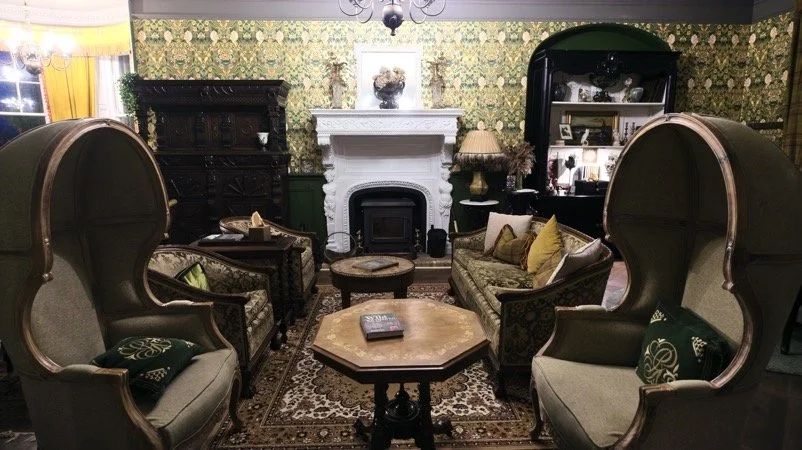
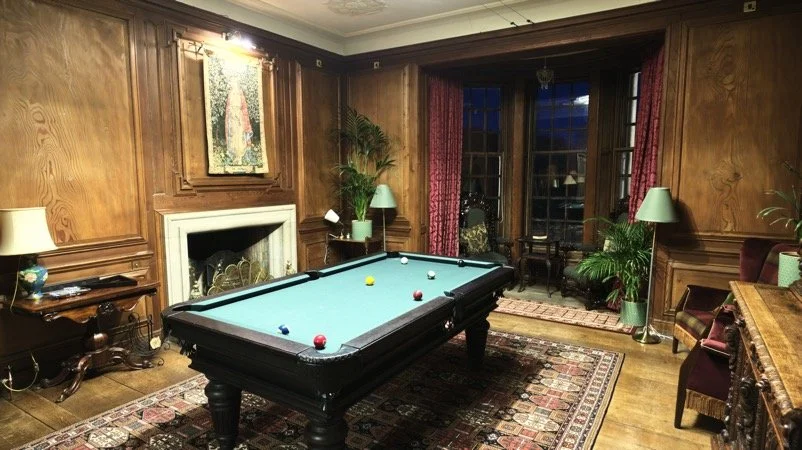
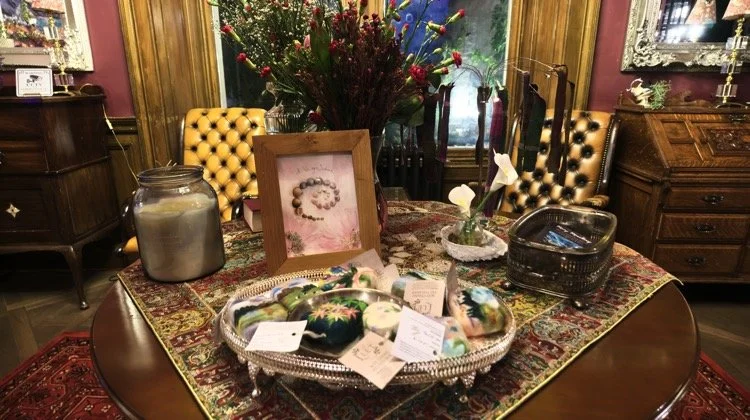
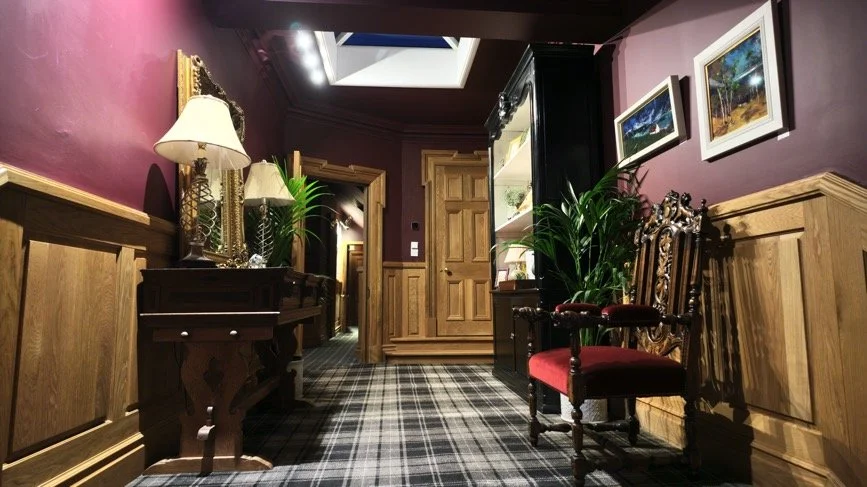
Reception alone tells you what kind of stay this is going to be: rich, dark colour on the walls, a huge ornate mirror, fresh flowers, and a glimpse through an archway toward a fireplace-lit room beyond. Wander further, and the house keeps giving — a little table of locally made candles near the door, a glass-fronted curiosity cabinet stuffed with trinkets, a billiard room with a mirror running the length of one wall, a lounge with a chandelier and a log burner sitting unlit for summer, a black piano waiting in the corner for someone braver than me to sit down and play.
The staircase up is the kind you photograph without meaning to — dark carved wood, a tartan runner held down the whole way with brass rods, sweeping round to a landing lit by a skylight. That's where the folklore theme properly announces itself: every guest room here is named after a figure from Highland myth, and mine was the Ghillie Dhu Retreat, after a gentle woodland spirit said to help lost travellers find their way home. After the drive up, I appreciated the thought.
Inside, the room plays the part beautifully — a carved wooden headboard against floral wallpaper, two windows I cracked open for the evening air, and a sitting corner with what I'm fairly sure is a portrait of the Ghillie Dhu himself keeping watch over the room he's named for. (Worth knowing if you're not travelling as a couple: there's an open gap rather than a door through to the bathroom.) That bathroom, in fairness, might be the single best reason to book this specific room — a fluted copper bathtub that catches the light like something from a different century entirely, alongside a separate walk-in shower with genuinely excellent pressure and some of the softest towels I've found in a hotel.
Even breakfast keeps the story going. I didn't film the room itself — it was busy, and it didn't feel fair to point a camera at other guests enjoying their morning — but the menu is worth mentioning on its own: Ghillie Dhu Khachapuri, Selkie Royale, Sìth Porridge. A hundred and thirty years after it was built, this house is still finding new ways to tell the same story.
Still Standing
A short walk into the woods behind the house, Alexander Mackay's Cathedral of Trees is still growing, nearly a hundred years after he planted it — a memorial that was only ever meant to keep changing rather than stay fixed in place. In its own, much smaller way, the house has done the same. It's been a family seat, a wartime billet, a religious retreat, and is now, somewhat improbably, one of the more memorable hotel stays I've had in a long time. I don't think Mackay would mind.
If You Go
- Location: a few minutes' drive from Oban town centre; Oban Distillery, the ferry terminal, and McCaig's Tower are all within about five minutes, and the Cathedral of Trees itself is a short walk from the house.
- Parking: plentiful, at the rear of the house.
- Getting around: rooms in the main house are reached via the grand staircase, with no lift — worth factoring in if stairs are a concern, and worth asking Glencruitten directly about step-free options.
- Bathroom layout: several rooms, including the Ghillie Dhu Retreat, have an open gap rather than a door between bedroom and bathroom.
- Booking: current rates and availability are on the Glencruitten House website.
I've put together a full video walkthrough of the stay, room by room — [watch it here]. And if Oban's on your list, I've also covered Barcaldine Castle, just up the road.